I remember heading upstairs to a friend's apartment and running into my buddy Fritz there. He had come over with the One From The Vault release (08/17/75) almost immediately after it came out (he was on the pre-order list), and was giving it a proper airing among friends. It was mid day, and the sun was shining in a hundred hues of orange and yellow that afternoon, seeming to rise (no pun intended) to the occasion. I was unprepared for what I heard. This was before I started collecting Dead tapes – my friend Fritz had been doing so since before I met him in the late 80's.
A week or so later I picked up a copy for myself. Was Jerry's ever-elevating solos in Eyes of the World something I imagined, or had he really started each solo section on a slightly higher note that the last one, lending an incredible growing sensation to the song? Well, it wasn't my imagination. And, while that release has more highlights than one can count, I was somehow transfixed by the quiet beauty of It Must Have Been The Roses. I played that track again and again.
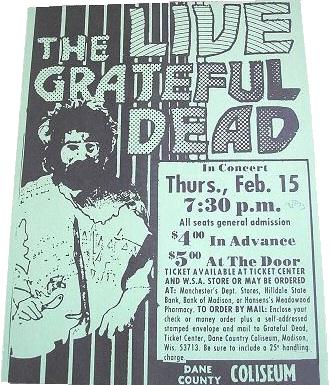
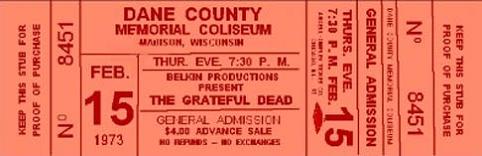
One evening shortly thereafter, I was ready. I headed over to Fritz's place and proclaimed my desire to check out some of his Dead tapes. I told him the logical place for me to start was 1975, because I wanted to hear more of what was happening on One From The Vault. Crushed to learn that the band was actually on a break that year, he sent me home with about five tapes; four of them were from 1973, as Fritz was pretty comfortable with my musical leanings, and knew these would scratch my itch. Set two from Dane County 02/15/73 was one of these tapes.
To say that I imprinted myself on 02/15/73 would be an understatement. The tape went with me everywhere. Phil and Jerry's tandem transition from Dark Star to Eyes is forever burned in my ears. As is the case with many pinnacle Dead moments, I can recall exactly where I was when I first hear it – sitting in my car in the parking lot, not able to turn off the engine and go into work because of what was coming out of the car speakers.
Now the show sits on www.archive.org, and has been downloaded nearly half a million times. It almost figures that if you're reading this Grateful Dead show review, you've already heard the show. If not, what sweet pleasure awaits you.
The first set finds the band in fine form. They aren't quite at the level that would come later in the month, or in March, but none-the-less, there isn't a wasted song anywhere. Jerry, in particular, sounds very happy to be playing and singing. The energy of the set is good, until we get to China>Rider. Here, we simply ride a rocket into the stratosphere. This version sizzles, as many do in early 1973. Maybe it's because the energy leaps so high, but for explosions of power, this China>Rider can certainly be held in the same light as 3/28, 7/1 and 7/31/73 (others that I've always held up a sleeve for just such a "best China>Rider of '73" discussion). The shift in energy is unmistakable. While the Me & My Uncle that follows is fair, the Bertha cooks with the same energy of IKYR. Playin' In The Band, however, goes to a whole other place.
All Playin' In The Bands from February '73 have stiff competition trying to claim the title of best Playin' from that month. That title rests pretty firmly on 2/24/73's shoulders. However, this 2/15 version packs great energy and variety into its slender 14 minute frame. There is some fantastic interplay between Jerry and Keith wherein they are exchanging mirrored phrases no more than a beat long each. It produces a climbing effect, like tightly intertwined vines climbing on each other. Later, Keith is working a volume pedal under the band and his piano sounds more like a third guitar than keys. It's quite a surprise (I don't recall much, if any, volume work from Keith after 1972). Before it ends, there's more lovely interweavings; the band swirling in on itself like a large school of fish in a bait ball. Suffice to say, this Playin' deserves multiple listenings, and the battle for best of Feb '73 may be a multi-round bout.
The second set finds more glimmers of high energy. The debut of "You Ain't Woman Enough" features a piercing, white hot solo by Garcia. But this set, not surprisingly, is all about the Dark Star>Eyes>China Doll.
This Dark Star is less like a star and more like a comet; speeding past galaxy after galaxy, exploring the beauty of each. Some are spiral, some are elliptical. Some are double galaxies locked in a million year collision. Some are at rest, and others are being consumed by black holes.
In the 13 minutes leading up to the verse, we zigzag billions of light years to and fro across the universe. The song opens with more energy than you'd expect. There's the sense of dancing candle lights rising and falling. One of Billy's cymbals seems to be arching up and down passed its microphone, providing a wonderful phasing effect. Things mount, as Phil and Jerry angle toward more and more aggressive play. Then it's as if we've been at sea during a storm, and the rain slows, mist settles, and land appears along with sunlight. Things draw down. Jerry is working his volume knob, and he had Phil reach a glorious moment of harmony at just about the 5:13 mark.
Hearing Jerry and Phil converge into this cord for the first time, on what was probably the first 1973 Dark Star I'd ever heard in my life, left me done for. I think it was at that very moment that I began my journey as a tape collecting deadhead. Now I understood why one might want to hear every version of the same song played by a band. This one Jerry/Phil moment is terribly fleeting. They didn't even seem to acknowledge having struck such a perfect improvisational high. They certainly didn't milk it (the Dead never did such a thing). But it was a glimmer of perfection amidst an already sensational playing sequence.
The song continues deeper into the yawning chasms of deeply drawn out notes where tempo seems to sit down and rest. Then it rises back up into more of the loping, playful Dark Star jamming associated with 1972. All in all, by the time we make it to Jerry delivering the vocals, we've been to many different places.
The post verse space sets off on a beautiful deconstruction of music. It begins with wide sweeping vibrations of flowering notes, settling in the basin of empty space with Phil taking a solo. Bobby continues a bit of whisper silent string tapping for a bit, and then Phil works the crowd into a lather for about two minutes. He gets the entire house to begin clapping in rhythm, and together they are working a wonderful vibe. Then Jerry returns.
This passage from Phil's solo into Eyes Of The World hits you in much the same way as that lovely one note convergence back near the start of Dark Star, except this now goes on for well over a minute. Jerry and Phil are completely zoned in and working pure magic. Then splashing into Eyes? More than one's heart can bear. If we had to pick just a few "under two minute" passages of Dead music to go into a time capsule, this would be one of them.
Eyes (the second live version of the song, mind you) is awesome. Billy's tempo on this version is the mold from which all future Eyes would emerge. Even as the song's tempo picked up over '73-'74, this 2/15/73 version can be pointed out as an archetypical delivery. Knowing what Jerry was doing in his side projects since 1972, he seems to have penned the music for Eyes of the World as a personal outlet for the R&B/Soul lover in him that had been playing instrumental versions of Expressway To Your Heart for the last year or more. The song bounces and lifts you to your feet.
Jerry also sits back for a number of measures after each verse, holding off from his solo. This allows us to bathe in the simple groove of the new song. It adds a nice layer to the song structure. Jerry's solos then appear and take us on with them. After the final verse, as the band heads into the meat of the song's exploration, I'm struck by visions of tightly bound and layered planetary rings, slowly spinning in opposite directions under your feet. They pervade the soundscape here. The band members stretch in opposing directions, circle back to each other, and explode outward again. This fabulous interplay is delivered a deathblow by a classic cut of death – a reel flip deep within the jam. It is expertly stitched together on the circulating copy, so you barely notice it. But I remember a three second gap on my cassette copy from way back when. Ouch.
Upon the pickup of the new reel, we are moments away from the thematic section of the song that's in a 7/8 time signature. It's fun, but clearly still in a formative stage. The band wraps things us and wind down into the second performance of China Doll. It's a pistol shot at 9 o'clock (not sure when the lyrics settled into the 5 o'clock slot), and the song is extremely heart-felt. Jerry is in fine voice. His solo at the end of the song is sweetly rolled out. It flows back and forth like breezes through trees. A few "La La La's" and it's over.
The show rolls on, but the peak has come and gone. There's a nice Uncle John's Band nestled in the tail end of the show, but you'll come back for the China>Rider, Playin, and one of the quintessential Dark Star>Eyes of the year.
Noah at Grateful Dead Listening Guide


 Running tunes from
 John Cougar